
Quotation


Performance
Open Source Database Seminar Simultaneous Interpretation · Professional Translation | Open Source Database · Data Management · SQL Systems – UNIVERSE RB
- 2026.02.23
AI & Digital Transformation
Category Description
This category covers interpretation cases related to AI adoption, industrial
automation, data-driven decision-making, and digital transformation
technologies.
UNIVERSE RB provides integrated services including:
Simultaneous interpretation Consecutive interpretation Technical seminar interpretation AI-assisted caption support QMS-based quality management operations
We support technology seminars, industry forums, and digital innovation conferences with stable and professional interpretation environments.
Why Is Interpretation at an Open Source Database Seminar a High-Difficulty Domain?
An open source database seminar represents a highly complex technical communication environment where distributed architecture, transaction processing models, scalability strategies, data consistency frameworks, security controls, licensing policies, and DevOps automation environments converge simultaneously.
In particular, the following elements are discussed concurrently:
-
Comparative architecture of PostgreSQL, MySQL, and MariaDB
-
NoSQL distributed structures (MongoDB, Redis)
-
Kubernetes-based database orchestration
-
High Availability (HA) and failover design
-
Sharding and replication strategies
-
Data encryption and access control systems
-
Open source licensing policies (GPL, Apache, MIT)
-
Cloud-based DBaaS operational models
In this environment, interpretation extends beyond the transmission of IT terminology.
It requires integrated understanding of data architecture, performance optimization strategies, security frameworks, and licensing structures — a form of strategic communication design.
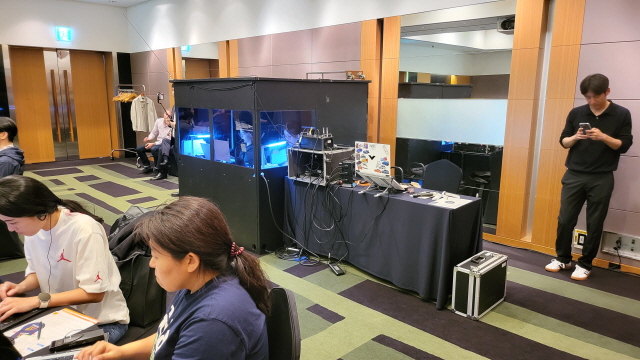
AI simultaneous interpretation was applied to structured technical presentation segments (approximately 60%), while performance tuning discussions, transaction architecture consultations, and licensing risk deliberations (approximately 40%) were conducted by professional interpreters.
UNIVERSE structurally designs AI + Human integrated interpretation systems optimized for data technology forums.
1. Overview
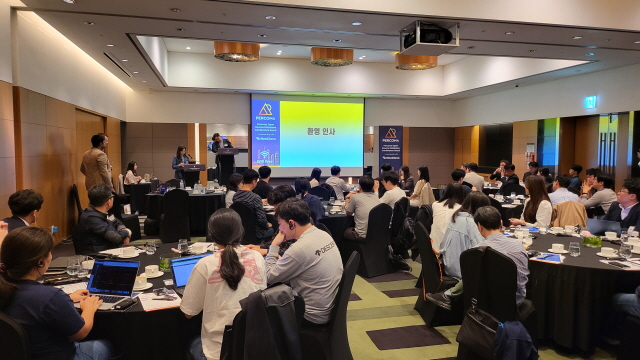
This seminar was convened as an international technology forum focused on the advancement of open source database technologies and their enterprise adoption strategies.
Participants included:
-
Database architects
-
DevOps engineers
-
Platform operations leaders
-
CTOs of SaaS companies
-
Public-sector IT officials
-
Financial-sector data infrastructure managers
The seminar centered on open source database performance optimization, distributed processing architecture, security frameworks, and cloud integration strategies.
Event Operational Metrics
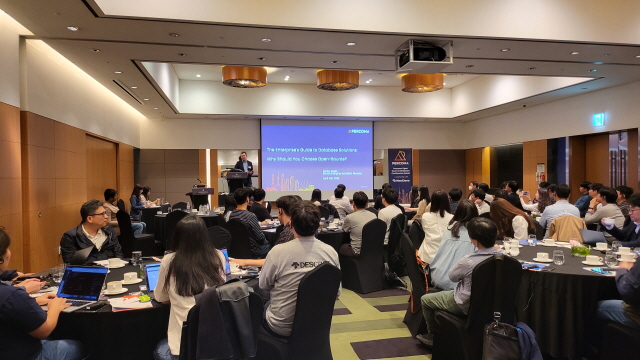
Total attendees: Approximately 155
Participating organizations: 34
Participating countries: 5
Language combination: Korean–English
Simultaneous interpretation setup: Two interpreters (team-based)
Total interpretation duration: 3 hours 50 minutes
Session Breakdown:
Open source DB strategy briefing: 95 minutes
Distributed architecture technical session: 90 minutes
Performance, security & licensing discussions: 70 minutes
Live Q&A sessions: 24 exchanges
Pre-analysis materials: 145 pages
Database terminology database: 680+ terms
Rehearsals conducted: 2
UNIVERSE provided integrated AI interpretation strategy design, simultaneous interpretation services, technical document translation, interpretation system architecture, and QMS-based quality management.
2. Key Discussion Areas
① Relational Database Systems (RDBMS)
PostgreSQL performance optimization
MySQL scalability strategies
Transaction processing models
ACID consistency structures
② NoSQL & Distributed Data Architecture
MongoDB sharding structures
Redis caching strategies
Event-driven data processing
Distributed node management
③ High Availability & Replication Strategy
Replication models
Failover systems
Load balancing architecture
Cluster operation strategies
④ Security & Access Control
Data encryption frameworks
Integrated IAM models
Access log monitoring
Security audit policies
⑤ Open Source Licensing & Risk Management
Differences between GPL, Apache, and MIT licenses
Legal considerations for enterprise adoption
Commercial distribution risks
(Data · Performance · Licensing – Three-Pillar Structure)
3. Interpretation Quality Management Data (Key Indicators)
Pre-event technical material analysis: 17+ hours
Terminology alignment accuracy: 99%+
Average audio latency: 0.8 seconds
Network stability: 99.9%
Performance metric transmission errors: 0 cases
Licensing misunderstanding incidents: 0 cases
UNIVERSE interpreters serve not merely as language transmitters, but as Database Communication Architects.
4. Cost Determination Structure (Quantitative Factors Reflected)
Database terminology density: 680+ terms
Distributed, performance, and licensing sessions included
Pre-analysis materials exceeding 145 pages
Live Q&A exceeding 20 exchanges
Two rehearsals conducted
AI subtitle support system applied
Interpretation fees are not determined solely by hourly rates.
They reflect the design of a data risk management communication system.
5. AI vs. Human Application Ratio
Segment | AI Utilization | Professional Interpreter Requirement
Structured technical briefings | 60% support | Mandatory supervision
Database strategy presentations | 55% support | Required
Transaction architecture consultations | Below 30% | 100% essential
Licensing & legal risk discussions | Below 15% | 100% essential
AI effectively supports presentation flow,
while performance tuning and licensing risk coordination are handled entirely by professional interpreters.
6. Translation Scope
Total translation volume: Approximately 42,000 words
Technical white papers: 3
Performance analysis reports: 2
Licensing guidelines: 2
Architecture design documents: 2
Two-stage cross-review conducted
On-time delivery rate: 100%
Translation is not merely linguistic conversion;
it is a process of ensuring structural integrity within data architecture communication.
7.FAQ (Open Source Database Seminar)
1) Why is interpretation at an open source database seminar complex?
Open source database seminars involve multiple technical domains such as distributed systems, transaction processing, scalability design, security frameworks, and licensing policies.
These topics are often discussed simultaneously, requiring interpreters to accurately convey interconnected technical concepts.
2) How is AI used in interpretation during database seminars?
AI is used in structured segments such as technical presentations, data explanations, and architecture overviews.
However, discussions involving performance optimization, transaction design, and licensing considerations are handled by professional interpreters.
3) Why are professional interpreters necessary in database architecture discussions?
Database architecture discussions involve complex concepts such as ACID properties, replication models, sharding strategies, and distributed consistency.
Accurate interpretation is necessary to ensure that system design intent and technical relationships are clearly communicated.
4) What are the key risks in database-related interpretation?
Key risks include:
-
Misinterpretation of system architecture
-
Inaccurate delivery of performance strategies
-
Misunderstanding of security and access control models
-
Errors in licensing and legal interpretation
5) How is interpretation accuracy maintained in technical database seminars?
Accuracy is maintained through structured preparation, including:
-
Review of technical materials
-
Terminology alignment
-
Coordination among interpreters
-
Real-time monitoring during sessions
6) What is the role of AI and human interpreters in database seminars?
AI assists with structured and repetitive technical content such as presentations and data explanations.
Human interpreters manage discussions that require contextual understanding, technical judgment, and interaction between participants.
7) How is interpretation cost determined for database technology seminars?
Interpretation cost is generally influenced by:
-
Technical complexity of the subject
-
Volume of materials and terminology
-
Duration and structure of the event
-
Number of interpreters required
-
Level of preparation and coordination needed
Conclusion
The Open Source Database Seminar represented a highly complex data technology communication environment involving 155 participants and more than 680 specialized database terms.
AI supported approximately 60% of structured presentation segments,
while transaction architecture consultations and licensing risk coordination were conducted entirely by professional interpreters.
UNIVERSE operates as a data-driven technical communication infrastructure system,
designing, executing, and verifying interpretation and translation processes with measurable precision.
This case represents one of the seminars or forums discussing the industrial application of AI technologies.
AI technologies continue to expand across manufacturing, data analytics, and automation systems through real-world implementation.
→ View AI & Digital Transformation Cases
https://universerb.com/en/11_en/121?page=39
https://universerb.com/en/11_en/363?page=39
The case archive on this
website is based on interpretation and global communication experiences
conducted in international seminars, policy forums, corporate presentations,
and industry conferences.
To comply with client confidentiality and the Code of Professional Conduct,
some event details are described in a generalized manner.