Quality


Quality Management
By managing all factors that affect quality,
we minimize variations in service.
QMS

- A service recognized by companies seeking opportunities in Asia.
- First full ATC membership approved in South Korea.
- Member of American Translators Association
- Quality Management System
As a service-oriented technical translation specialist, U&I Verse and Rolling Bridge manage KPI (Key Performance Indicator) targets to enhance service quality, implement Quality Monitoring processes for continuous service improvement, and operate a performance recognition program to motivate professional staff.
ATA

- Membership Criteria
- Professional Interpreter/translator
- Code of Professional Conduct & Business Practice
- Consistent Service Quality
- False Ad Van & Fair Trading
Founded in 1959, the ATA (American Translators Association) is the largest translation and interpreting association in the United States, with more than 10,000 members across 80 countries worldwide.
The primary goal of the ATA is to foster and support the translation and interpreting professions. To be recognized as a certified professional translator or interpreter, one must be qualified the association’s criteria and comply with the Code of Professional Conduct and Business Practices.
ATC
- Membership Criteria
- Professional Indemnity Insurance
- Code of Professional Conduct
- Verification of the establishment of a system ensuring operational accuracy
- Meeting business operation standards
- Obligation to employ at least one or more personnel certified by ATC
- Function as an organization overseeing commercial ethics and mediating disputes
The ATC (Association of Translation Companies), established in the United Kingdom in 1976, is the world’s oldest interpreting and translation association.
To become a full member of the ATC, a company must be covered by professional indemnity insurance and demonstrate compliance with the Code of Professional Conduct, which has now become the global standard in the translation and interpreting industry.
In addition, members are required to establish a system that ensures and verifies operational accuracy, present standards for business operations over an appropriate period, and fulfill the obligation to employ a suitable number of ATC-accredited staff.
Furthermore, members must maintain facilities appropriate for their professional activities, meet strict conditions regarding confidentiality and data security, adhere to fair trade obligations, and avoid misleading or exaggerated advertising.
As a founding member of the European Union of Associations of Translation Companies, the ATC not only protects clients’ rights but also oversees ethical practices in commercial transactions between translation and interpreting companies and serves as a dispute arbitration body within the industry.
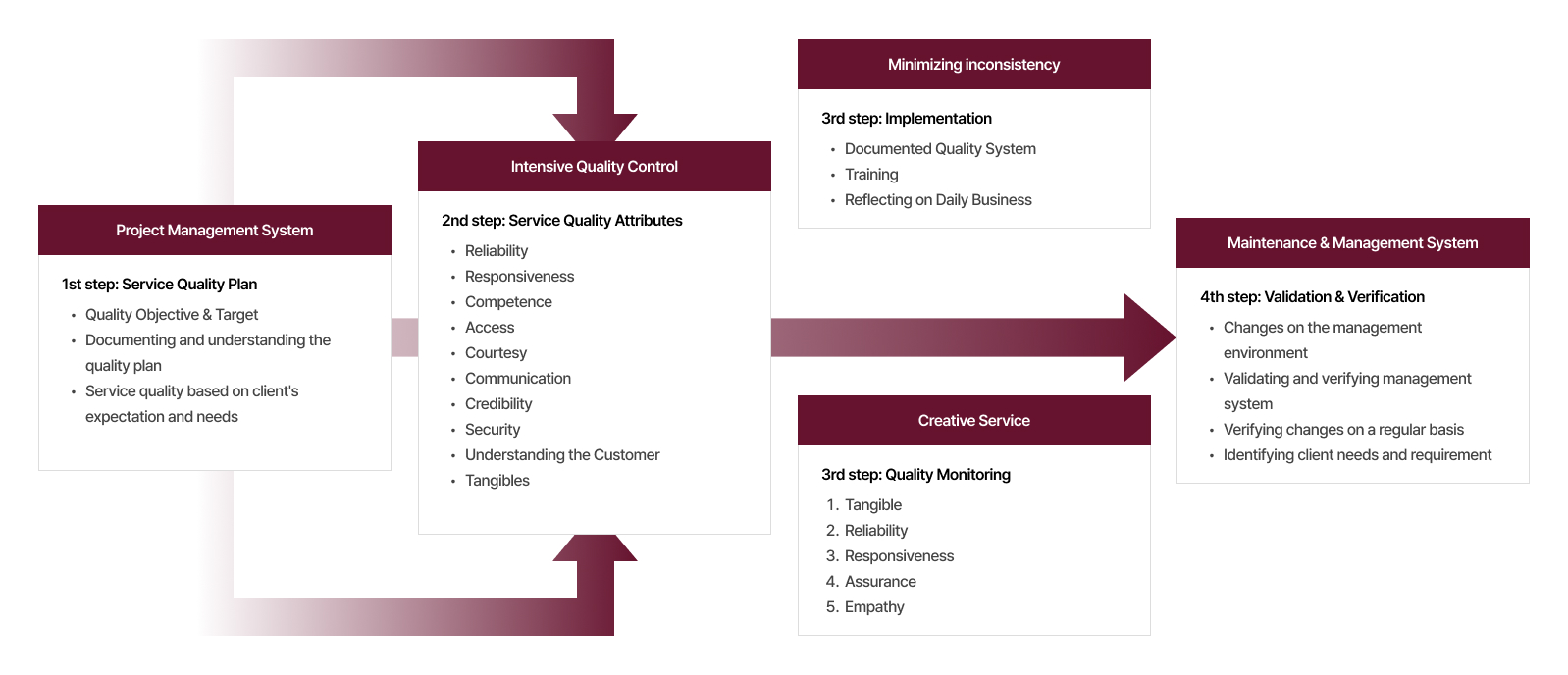
Quality Management Procedures
- 1st step Defining policies and measures to improve quality
- 2nd step Establishment of quality objectives
- 3rd step Monitoring to ensure the implementation of quality policies and maintenance of appropriate standards
- 4th step Periodic review of the adequacy and effectiveness of the quality system, including quality policies
The quality policy, objectives, and commitments are documented and communicated company-wide. Policies are established based on customer expectations and needs, with measurable service quality goals. Staff receive relevant training, and operations follow documented procedures with results recorded and reviewed. The system’s adequacy and effectiveness are periodically assessed, and policies are updated as needed to continuously meet customer requirements.