
Quotation


Performance
[FAQ] Is AI Subtitle Display Suitable for Events with a 300-Inch Screen?
- 2026.02.21
FAQ | AI Subtitle Systems · Venue Requirements for International Events
1) How are AI subtitles used during events?
AI subtitle systems convert spoken content into real-time text and display it on screens or participants’ devices.
They may be effective for:
- International seminars
- Technical presentations
- Multilingual events
- Large-scale conferences
- Internal information-sharing sessions
- Accessibility and reference support
AI subtitles can provide:
- Visual reinforcement of spoken content
- Reference-level multilingual support
- Improved accessibility
- Additional support in noisy environments
- Assistance for audiences unfamiliar with the speaker’s accent
However, AI subtitles should generally be treated as visual communication support rather than a guaranteed replacement for professional interpretation.

2) Can an international conference be operated using only AI subtitles?
It may be possible for low-risk, information-sharing events, but it is generally not recommended for official or decision-critical international conferences.
AI systems may still produce:
- Semantic errors
- Misrecognition of technical terminology
- Incorrect proper nouns
- Numerical errors
- Delayed subtitles
- Limited contextual interpretation
- Errors caused by accents or unclear audio
- Confusion when speakers overlap
Professional human interpretation is recommended when the event involves:
- Diplomatic or policy communication
- Medical or legal information
- Investment decisions
- Technical safety
- Executive negotiations
- Confidential discussions
- Live Q&A with complex context
For high-risk events, a human-led hybrid model combining professional interpretation with AI-assisted subtitles provides a more reliable structure.
3) Why combine AI subtitles with professional interpretation?
AI subtitles and professional interpreters serve different roles.
AI Subtitle Functions
- Visual reinforcement
- Real-time text reference
- Accessibility support
- Keyword visibility
- Reference captions for participants
- Searchable post-event text, where permitted
Professional Interpreter Functions
- Accurate meaning transfer
- Contextual interpretation
- Specialized terminology control
- Numerical verification
- Speaker-intent delivery
- Diplomatic and cultural nuance
- Real-time response to unscripted discussion
A hybrid model can improve audience comprehension while maintaining human control over high-risk communication.
The recommended structure is:
AI-assisted support · Professional human responsibility
4) What screen environment is recommended for AI subtitles?
Readability is more important than a fixed screen size.
The appropriate screen configuration depends on:
- Venue dimensions
- Audience size
- Distance from the screen
- Number of subtitle languages
- Font size
- Number of subtitle lines
- Stage lighting
- Viewing angles
- Existing presentation content
- Availability of auxiliary monitors
A 300-inch or larger main screen may be appropriate for a large ballroom or conference hall, but it is not a universal minimum requirement.
A smaller screen may be sufficient in a compact venue if every attendee can read the subtitles comfortably.
The technical team should verify subtitle readability from the farthest and least favorable seating positions before the event.
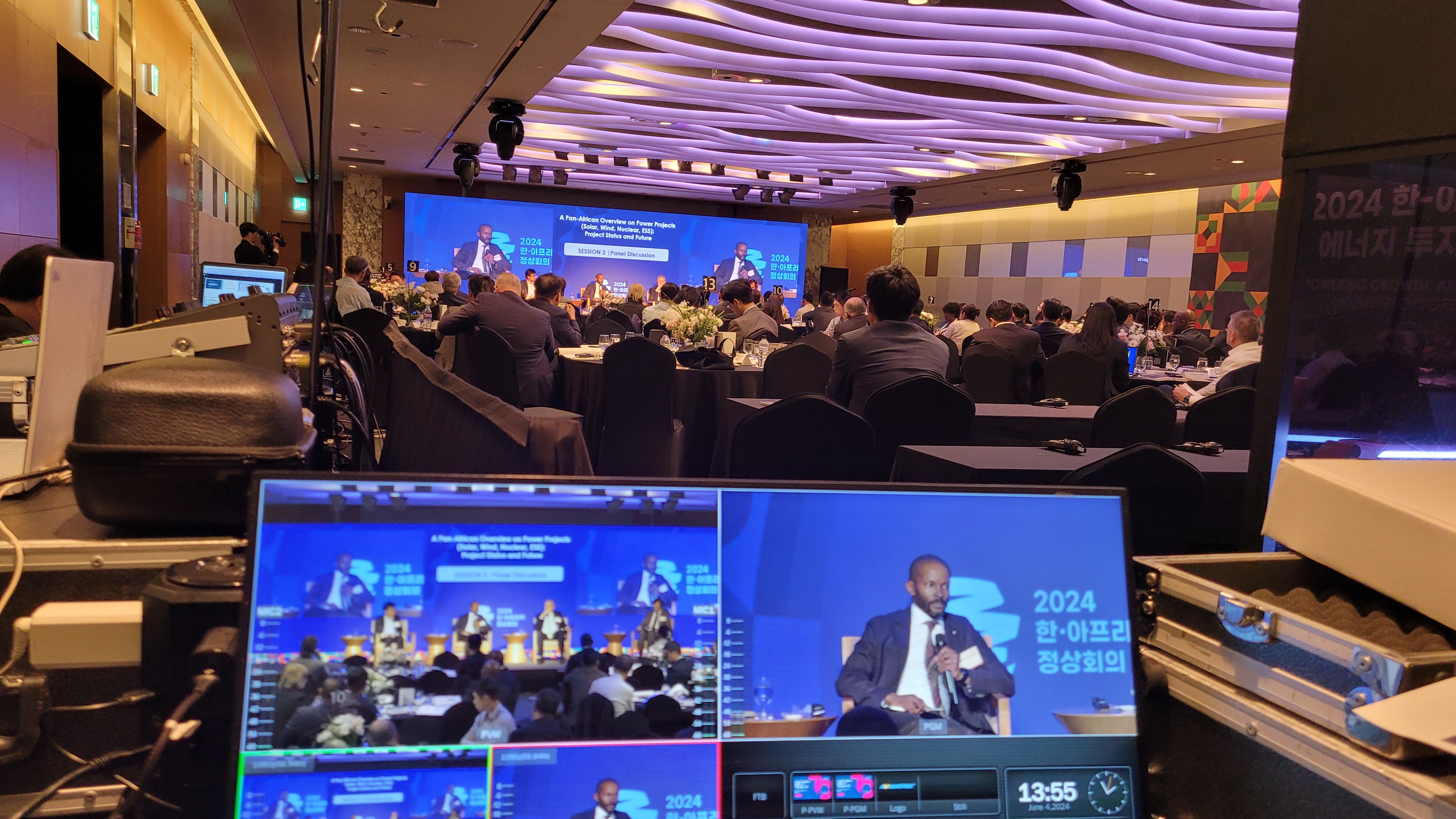
5) Can multiple 70-inch screens replace one large projection screen?
Yes, depending on the venue layout.
Multiple 70-inch displays may be effective when:
- Screens are distributed throughout the venue
- The room is long or divided into seating zones
- Each audience section has a clear viewing angle
- Subtitle text is displayed consistently
- Video signals are synchronized
- Cable routing and power supplies are stable
This approach may be more effective than one central screen when side or rear seating has poor visibility.
However, possible limitations include:
- Fragmented audience focus
- Inconsistent viewing distances
- Differences in color or brightness
- Synchronization problems
- Additional cabling and signal distribution
- Reduced visual impact for large formal events
The decision should be based on sightline analysis and subtitle readability rather than screen size alone.
6) What venue conditions are suitable for AI subtitle systems?
A suitable venue should provide:
- Clear audience sightlines
- Adequate screen or display capacity
- Stable power supplies
- Professional audio input
- Controlled stage lighting
- Reliable wired internet
- Space for technical operation
- Audio-routing access
- Sufficient setup and rehearsal time
- Backup display and network options
Hotel ballrooms, convention centers, auditoriums, seminar rooms, and corporate conference facilities may all be suitable if these technical conditions are met.
A venue’s brand or rating does not guarantee compatibility. The actual audio, display, network, and operating environment must be inspected.
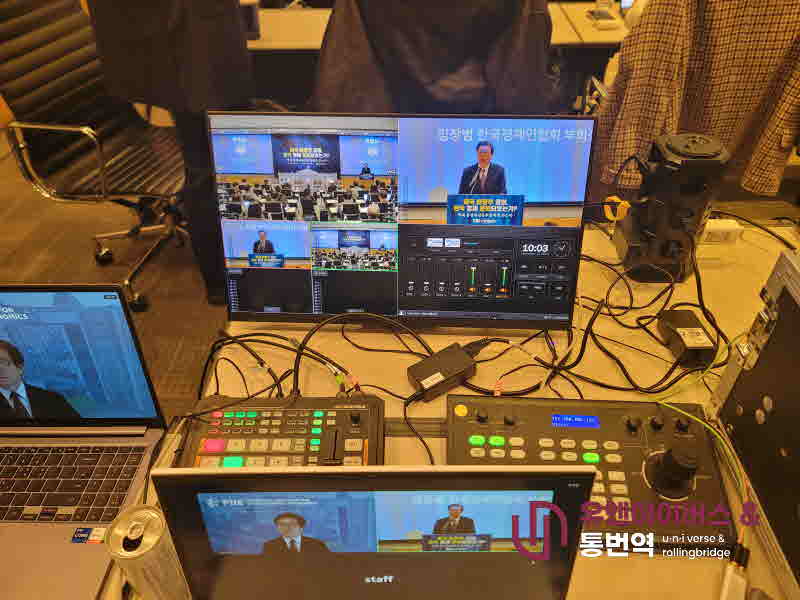
7) How is an AI subtitle system configured?
A professional AI subtitle system may include:
- Speaker microphones
- Audio mixer or digital console
- Clean audio feed for speech recognition
- Audio-channel separation
- AI speech-recognition engine
- Translation and terminology engine
- Subtitle-generation software
- Screen or display distribution system
- Real-time monitoring interface
- Recording and archive system
- Backup network and display options
- Technical operator
Additional systems may be required when the event includes:
- Multiple source languages
- Several subtitle languages
- Simultaneous interpretation
- Hybrid participation
- Live streaming
- Recording and rebroadcasting
- External media transmission
- Separate venue and online outputs
The AI engine is only one component of the complete system. Audio quality, display visibility, network stability, and real-time monitoring directly affect the final result.
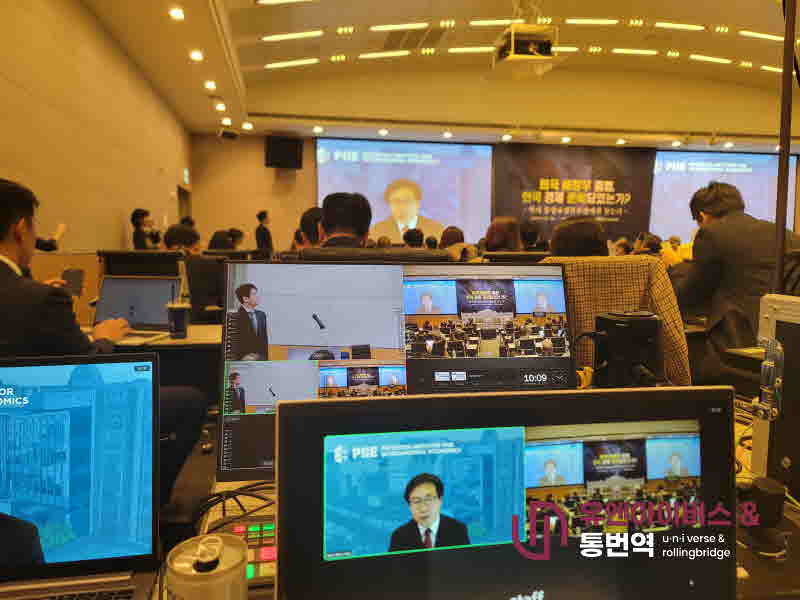
Screen Configuration Guide
Venue Structure | Possible Display Configuration |
Small seminar room | One appropriately sized front display |
Medium conference room | Main screen with one or two auxiliary monitors |
Large ballroom | Large central projection or LED screen |
Long or wide venue | Central screen with distributed side displays |
Divided seating areas | Multiple synchronized displays |
Hybrid event | Venue screens plus online caption output |
Multilingual conference | Separate subtitle areas or participant-selectable devices |
Subtitle Readability Guidelines
Effective subtitles should use:
- High text-to-background contrast
- Large, readable fonts
- Short line lengths
- Limited text density
- No more lines than the screen can display clearly
- Consistent language labels
- Stable display timing
- Minimal overlap with presentation graphics
- Appropriate placement within the audience’s natural sightline
For multilingual subtitles, displaying too many languages simultaneously may reduce readability. Where possible, language selection should be separated by screen, channel, or participant device.
Important Operating Principle
AI subtitle quality depends first on the source audio.
Even an advanced AI engine may perform poorly when:
- Microphones are too far from speakers
- Several people speak simultaneously
- Background noise is excessive
- Audio is compressed or distorted
- Technical terms are not registered
- Network transmission is unstable
A complete system therefore requires:
Clear audio input → Stable AI processing → Readable subtitle display → Real-time human monitoring
If one stage fails, the quality of the entire subtitle system may decline.
Recommended Use by Event Type
Event Type | Recommended Configuration |
Internal information-sharing meeting | AI subtitles may be sufficient |
General seminar | AI subtitles with technical monitoring |
Large technical presentation | AI subtitles with glossary preparation and large-screen display |
Diplomatic or policy forum | Professional interpretation with AI subtitle support |
Medical, legal, or financial event | Professional interpretation as the primary channel |
Executive meeting or negotiation | Professional human interpretation |
Large multilingual conference | Human-led interpretation system with optional AI captions |
Accessibility-focused event | AI captions with human monitoring or professional captioning |
Closing Statement
Successful AI subtitle operation depends on more than speech-recognition software.
Audio quality, terminology preparation, screen visibility, signal distribution, network stability, and technical monitoring must be designed as one integrated system.
UNIVERSE RB configures AI-assisted subtitle environments according to venue structure, audience size, language requirements, and communication risk.
Technology-Enhanced. Expert-Led.
Quality is engineered.
Final Conclusion
Choosing an interpretation company is ultimately about choosing a communication partner.
While company size, revenue, certifications, and market visibility provide useful context, they do not by themselves determine the success of multilingual communication.
Successful outcomes are achieved through careful preparation, experienced professionals, effective project management, and a communication strategy aligned with the objectives of the event.
At UNIVERSE RB, we believe that the best interpretation projects are built on preparation rather than improvisation, systems rather than assumptions, and communication outcomes rather than marketing claims.
Our role is not simply to translate words.
Our role is to help organizations communicate with confidence across languages, cultures, and industries.

About Our Case Archive
The case studies and project insights presented on this website are based on experience supporting international conferences, investor presentations, government forums, executive meetings, technical seminars, and multilingual corporate events.
To protect client confidentiality and comply with the Code of Professional Conduct followed by professional interpreters worldwide, certain project details have been generalized, anonymized, or adapted for educational purposes.
The purpose of these materials is to share practical insights into multilingual communication planning while respecting the confidentiality of every client and every project.
UNIVERSE RB
Designing Communication. Managing Risk. Delivering Understanding.