
Quotation


Performance
Why Do Professional Interpreters Deliver Different Results?
- 2026.08.13
How Industry Expertise and Event Experience Determine Interpretation Quality
Why can two interpreters working in the same language pair produce very different results?
The difference is rarely foreign-language ability alone.
In professional interpretation, results are strongly influenced by:
Industry Expertise + Event Experience + Contextual Understanding + Real-Time Judgment
An interpreter who understands the terminology, objectives, and communication structure of a particular industry can reduce misunderstandings and support more reliable communication throughout the event.
For international conferences, investment meetings, medical seminars, technical events, and government forums, professional interpretation therefore requires much more than bilingual fluency.

Executive Summary
Professional interpreters are not simply people who speak two languages well.
They are communication specialists who combine:
- Language proficiency
- Industry-specific knowledge
- Professional interpretation experience
- Terminology management
- Contextual understanding
- Real-time communication judgment
Two interpreters may have similar language ability but produce very different outcomes if one understands the subject matter and the other does not.
Key Insight
Professional interpretation quality is determined not only by language skills, but by how well the interpreter understands the industry, the event, and the communication objective.
1. Can Anyone Who Speaks Two Languages Be an Interpreter?
Not necessarily.
Speaking two languages and interpreting professionally are different capabilities.
Professional interpretation requires the interpreter to:
- Listen and analyze simultaneously
- Understand specialized terminology
- Follow the speaker’s logic
- Identify the intended meaning
- Respond in real time
- Maintain communication flow
- Manage unexpected questions
- Preserve tone and nuance
This becomes especially important when the discussion involves:
- Financial figures
- Technical terminology
- Medical information
- Government policy
- Contractual conditions
- Investment decisions
A bilingual speaker may understand the words.
A professional interpreter must understand what those words mean in context and why they matter.
2. One-Sentence Answer
A professional interpreter does more than translate language—they use industry knowledge and experience to support accurate communication in complex professional environments.
3. When Is a Professional Interpreter Needed?
Professional interpreters are particularly important for:
- International conferences
- Global policy forums
- Contract negotiations
- Investment meetings
- Investor Relations (IR)
- International buyer meetings
- Government and public-sector events
- Medical and pharmaceutical seminars
- GMP conferences and audits
- Technical conferences
- Academic symposiums
- Corporate training
- Global workshops
- Executive meetings
These environments share one important characteristic:
Communication can directly influence decisions, trust, and outcomes.
4. Key Characteristics of Professional Interpretation
Category | Professional Interpretation |
Interpreter Selection | Based on event objectives, subject expertise, and communication complexity |
Communication Flow | Maintains natural presentation and discussion flow |
Accuracy | Manages specialized terminology, context, numbers, and intent |
Industry Expertise | Finance, medical, technical, policy, legal, manufacturing, and other specialized fields |
Staffing | Interpreters and operational staff are selected according to event complexity |
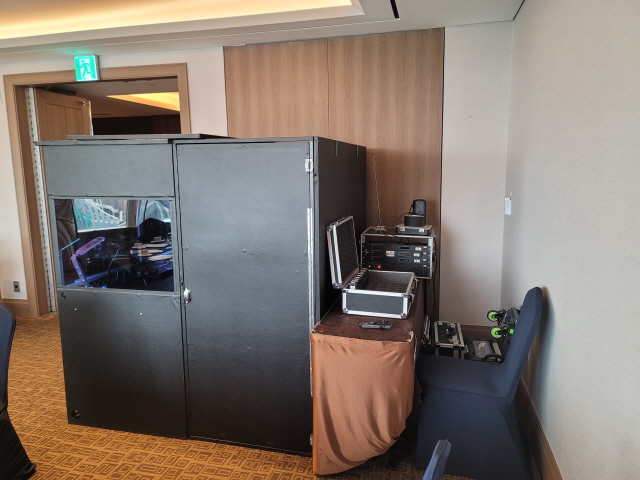
Equipment | Simultaneous interpretation may require booths, consoles, receivers, and audio systems |
Pricing | Influenced by specialization, event complexity, preparation, and operating structure |
Best Suited For | Conferences, negotiations, academic events, technical seminars, and high-value business communication |
Key Principle
Good interpretation begins with understanding the subject—not simply knowing the language.

5. Language Ability vs. Professional Interpretation Expertise
Area | General Bilingual Communication | Professional Interpretation |
Language Ability | Important | Essential |
Industry Knowledge | Limited or variable | Assignment-specific |
Terminology | General | Specialized and prepared |
Context | Basic understanding | Professional contextual interpretation |
Real-Time Judgment | Limited | High |
Q&A Handling | Variable | Professional real-time response |
Preparation | Minimal | Materials and terminology reviewed |
Communication Risk | Suitable for low-risk situations | Designed for complex or high-risk communication |
The difference is therefore not simply vocabulary.
It is the ability to connect:
Language + Industry Knowledge + Context + Communication Objective
6. Why Industry Expertise Matters
The same word can carry very different meanings across industries.
Professional interpreters working in specialized fields may need to understand terminology relating to:
Investor Relations and Finance
- Revenue
- EBITDA
- Valuation
- Market capitalization
- Guidance
- Shareholder returns
- Investment risk
Medical and Pharmaceutical
- Clinical trials
- Adverse events
- Regulatory approval
- GMP
- Dosage
- Treatment protocols
- Medical devices
Engineering and Technology
- Production processes
- Semiconductor technology
- Artificial intelligence
- Cloud infrastructure
- Database architecture
- Manufacturing systems
- Technical specifications
Government and Policy
- Regulation
- Public policy
- Institutional terminology
- International cooperation
- Official statements
- Governance
Correctly understanding the concept behind a term is often more important than finding a literal translation.
7. Why Event Experience Matters
Industry knowledge alone is not enough.
Professional interpreters also need to understand how different events operate.
For example:
Event Type | Required Capability |
International Conference | Fast processing, presentation flow, terminology consistency |
IR Meeting | Financial terminology, numerical accuracy, investor Q&A |
Negotiation | Intent, tone, conditions, clarification |
Medical Seminar | Technical terminology and scientific accuracy |
Government Meeting | Institutional language, neutrality, official communication |
Press Conference | Immediate response and unpredictable questions |
Technical Workshop | Detailed concepts and interactive communication |
An interpreter who performs well at one type of event may not automatically be the best choice for another.
Key Insight
Professional interpreter selection should be based on fit—not simply seniority.

8. Real-World Application Examples
Case 1 — International Investment Meeting
Situation
A company met with international investors to discuss:
- Business performance
- Growth strategy
- Market outlook
- Financial results
- Future investment plans
Interpretation Requirement
The interpreter needed familiarity with:
- Financial terminology
- Investment concepts
- Numerical information
- Investor questions
- Executive communication
Outcome
The appropriate subject-matter interpreter helped maintain clear communication between management and investors throughout the discussion.
Case 2 — GMP International Seminar
Situation
A pharmaceutical seminar covered:
- GMP requirements
- Manufacturing procedures
- Quality management
- Regulatory standards
- Technical Q&A
Interpretation Requirement
The interpreter required medical, pharmaceutical, or GMP familiarity.
Outcome
Specialized terminology and questions could be handled more consistently because the interpreter understood the subject matter behind the terminology.
Case 3 — Government International Conference
Situation
A government-related international conference involved:
- Policy presentations
- Institutional terminology
- International participants
- Panel discussion
- Live Q&A
Interpretation Requirement
The interpreter needed experience with:
- Policy terminology
- Government communication
- Formal presentation style
- International conference operation
Outcome
Subject knowledge and conference experience supported clearer communication across presentations and discussions.
9. Why the Same Language Pair Can Produce Different Results
Consider two Korean–English interpreters.
Both may have excellent English.
However:
Interpreter A
- General business experience
- Limited medical terminology
- No GMP event experience
Interpreter B
- Pharmaceutical event experience
- GMP terminology familiarity
- Previous regulatory seminar assignments
For a pharmaceutical GMP seminar, Interpreter B is likely to be the more appropriate choice.
The difference is not simply language ability.
It is assignment fit.
10. What Professional Interpretation Companies Should Evaluate
Before assigning an interpreter, professional providers should assess:
- Event purpose
- Subject matter
- Speaker profile
- Audience profile
- Presentation structure
- Q&A intensity
- Communication risk
- Industry terminology
- Interpretation method
- Event duration
- Technical environment
Only after this assessment should the interpreter be selected.
The Objective
The goal is not to find:
“the most expensive interpreter.”
The goal is to find:
“the interpreter whose expertise best matches the assignment.”
11. Interpreter Expertise vs. Event Fit
Selection Approach | Likely Result |
Language pair only | High variability |
Availability only | Risk of expertise mismatch |
Price only | May reduce subject-matter fit |
Experience only | Better, but still incomplete |
Industry expertise + event experience + communication risk | Strongest assignment fit |
This is why professional interpreter selection should be part of a broader quality-management process.
12. How Professional Expertise Can Reduce Communication Risk
Professional interpretation cannot guarantee a business or event outcome.
However, it can reduce avoidable communication problems.
Communication Risk | Professional Capability |
Terminology errors | Industry knowledge |
Context misunderstanding | Subject-matter familiarity |
Numerical mistakes | Professional processing and preparation |
Q&A difficulties | Real-time interpretation experience |
Negotiation nuance | Contextual judgment |
Policy ambiguity | Institutional terminology experience |
Technical misunderstanding | Industry-specific knowledge |
The purpose is not to influence the decision.
It is to help participants make decisions based on accurately understood communication.
13. AI + Human Strategy
AI can help professional interpreters prepare more efficiently.
AI Support
AI may assist with:
- Document analysis
- Terminology extraction
- Acronym identification
- Glossary preparation
- Background research
- Numerical consistency checks
Professional Interpreter
Human professionals remain responsible for:
- Context
- Meaning
- Q&A
- Speaker intent
- Negotiation nuance
- Cultural communication
- Real-time judgment
Key Principle
AI supports preparation. Professional expertise manages communication.
14. What Buyers Should Check Before Selecting an Interpreter
Before selecting an interpretation provider, ask:
Buyer Question | Why It Matters |
Does the interpreter know our industry? | Determines terminology accuracy |
Has the interpreter handled similar events? | Determines operational familiarity |
What materials will be reviewed? | Improves preparation |
How will terminology be managed? | Improves consistency |
How will Q&A be handled? | Tests real-time capability |
Is the interpretation method appropriate? | Affects communication flow |
How is the interpreter selected? | Reveals assignment methodology |
What quality-management process is used? | Reduces dependence on individual performance |
A professional interpretation company should be able to explain why a particular interpreter is appropriate for the event.
15. Frequently Asked Questions
Q1. Is being fluent in two languages enough to become a professional interpreter?
No.
Professional interpretation also requires interpretation skills, real-time processing, subject-matter understanding, preparation, and professional experience.
Q2. Why can two interpreters using the same languages produce different results?
Because their subject expertise, preparation, event experience, and real-time judgment may be different.
Q3. Is the most experienced interpreter always the best interpreter?
Not necessarily.
An interpreter with the most relevant industry experience may be more appropriate than a more senior interpreter from another specialization.
Q4. Why is industry expertise important?
Specialized events use terminology, concepts, and communication conventions that cannot always be understood through general language proficiency alone.
Q5. When is a specialist interpreter most important?
Specialist interpreters become especially valuable for:
- Investment
- Finance
- Medical
- Pharmaceutical
- Engineering
- Technology
- Policy
- Legal
- Technical negotiations
Q6. Does professional interpretation cost more?
It can.
Pricing may reflect industry specialization, preparation requirements, event complexity, interpretation method, and communication risk.
The objective is to select the level of expertise actually required rather than automatically selecting the highest-cost option.
Q7. Can AI replace industry-specialist interpreters?
AI can assist with terminology research and document preparation.
However, professional events often involve context, spontaneous questions, intent, and real-time judgment that still require human expertise.
Key Takeaway
Professional interpretation quality is not determined by foreign-language ability alone.
It depends on:
Language Ability + Industry Expertise + Event Experience + Preparation + Real-Time Judgment
The right interpreter is therefore not simply the person who speaks the language best.
It is the professional who best understands the communication environment in which that language is being used.
Final Conclusion
Why can professional interpreters working with the same language pair deliver different results?
Because interpretation involves much more than language.
A successful professional interpreter must understand:
- The industry
- The terminology
- The communication objective
- The event structure
- The audience
- The questions
- The context behind the message
For routine communication, general interpretation may be sufficient.
For international conferences, investment meetings, contract negotiations, government forums, medical seminars, and technical conferences, subject-matter expertise becomes increasingly important.
The most important question is therefore not:
“How good is the interpreter's English?”
It is:
“How well does this interpreter understand the communication we need to deliver?”
That is the difference between language ability and professional interpretation.
About Our Case Archive

The case studies and project insights presented on this website are based on experience supporting international conferences, investor presentations, government forums, executive meetings, technical seminars, and multilingual corporate events.
To protect client confidentiality and comply with the Code of Professional Conduct followed by professional interpreters worldwide, certain project details have been generalized, anonymized, or adapted for educational purposes.
The purpose of these materials is to share practical insights into multilingual communication planning while respecting the confidentiality of every client and every project.
UNIVERSE RB
Designing Communication. Managing Risk. Delivering Understanding.