
Quotation


Performance
Interpretation Cost Guide (2026) Consecutive Interpretation · Simultaneous Interpretation · International Events · Business Communication
- 2026.07.26
The same interpretation service can produce very different outcomes. UNIVERSE RB designs the communication structure behind successful international events.
Executive Summary
Interpretation fees are not determined by time alone.
The final project cost depends on:
- Event format
- Communication objectives
- Language combination
- Subject complexity
- Q&A requirements
- Audience size
- Interpretation equipment
- Onsite technical operation
- Communication risk

Typical Project Cost
- Consecutive Interpretation: USD 350–850+
- Simultaneous Interpretation: USD 1,400–2,800+
- Large International Conferences: USD 3,500–5,000+
Actual quotations vary depending on the complete project scope.
A two-hour business meeting, an investor presentation with executive Q&A, and an international conference with simultaneous interpretation equipment may have the same duration but require completely different operating structures.
The key principle is simple:
Interpretation costs are determined by event structure and communication risk—not simply by time.
What Determines Interpretation Costs?
Professional interpretation pricing is not simply a calculation of interpreter hours.
An accurate quotation should reflect:
- What the event is designed to achieve
- Who will participate
- What decisions may result from the communication
- How much specialist knowledge is required
- Whether the program includes live Q&A
- How the audience will receive each language
- What technical and operational risks must be controlled
This approach is especially important for:
- International seminars
- Investor Relations events
- Business negotiations
- Policy forums
- Medical and healthcare sessions
- Technology presentations
- Multilingual conferences
UNIVERSE RB approaches interpretation as a communication risk-management system, not simply a language placement service.
Typical Event Types
Event Category | Typical Applications | Recommended Method |
Dialogue-Centered Events | Business meetings · Negotiations · Interviews · Small briefings | Consecutive Interpretation |
Presentation-Centered Events | International seminars · Forums · Conferences · Corporate presentations | Simultaneous Interpretation |
High-Stakes Specialist Events | IR · Public policy · Technology · Medical · Multinational expert discussions | Consecutive or Simultaneous, depending on structure |
When the nature of an event changes, the interpretation method, staffing plan, technical system, and project budget must also change.
Consecutive vs. Simultaneous Interpretation
Category | Consecutive Interpretation | Simultaneous Interpretation |
Delivery Method | Interpretation after the speaker pauses | Real-time interpretation while the speaker continues |
Communication Structure | Dialogue-centered | Presentation-centered |
Typical Applications | Meetings · Negotiations · Interviews · Consultations | Conferences · Seminars · Forums · Large presentations |
Core Skills | Accuracy · Judgment · Dialogue coordination · Contextual understanding | Real-time processing · Rapid comprehension · Concentration · Subject expertise |
Equipment | Usually unnecessary or minimal | Booths, consoles, receivers, and audio systems may be required |
Main Risk | Distortion of meaning or negotiation flow | Real-time information loss or system failure |
Cost Structure | Primarily interpreter expertise | Interpreter team · Technical system · Onsite operation |
Operating Model | Person-centered communication | System-centered communication |
Consecutive Interpretation
Consecutive interpretation is suitable when participants need to communicate directly, discuss issues, negotiate, or make decisions.
Common applications include:
- Business meetings
- Executive discussions
- Contract negotiations
- Interviews
- Site visits
- Small seminars
- Advisory sessions
- Investor meetings
- Medical consultations
The interpreter delivers the message after the speaker pauses.
The primary cost drivers are the interpreter’s subject expertise, contextual understanding, judgment, and ability to preserve the flow and intent of the conversation.
Typical Consecutive Interpretation Cost
Project Type | Typical Scope | Typical Fee |
General Business Meeting | Approximately two hours · General discussion | USD 350–550 |
Negotiation or Interview | Approximately four hours · Discussion and coordination | USD 550–850 |
Specialist Consecutive Interpretation | IR · Contracts · Finance · Medical · Technical meetings | USD 850+ |

Simultaneous Interpretation
Simultaneous interpretation is suitable when speakers must continue without interruption and a larger audience requires real-time language access.
Common applications include:
- International conferences
- Global seminars
- Policy forums
- Corporate conventions
- Investor presentations
- Product launches
- Panel discussions
- Multilingual events
Simultaneous interpretation is delivered while the speaker continues speaking.
The project may require:
- Two interpreters per language
- Interpretation booths
- Interpreter consoles
- Wireless receivers
- Audio distribution systems
- Language channel routing
- Onsite engineers
- Installation and dismantling
- Technical rehearsals
Typical Simultaneous Interpretation Cost
Project Type | Typical Scope | Typical Fee |
Small Simultaneous Interpretation Event | 50–100 participants · Presentation-centered seminar | USD 1,400–2,100 |
Medium Simultaneous Interpretation Event | Medium-scale or multilingual event | USD 2,100–3,500 |
Large International Conference | Multilingual forum · Large audience · Expanded technical system | USD 3,500–5,000+ |
Why Interpretation Costs Vary
1. Event Structure
A scripted presentation is very different from an event involving panel discussions, negotiations, live questions, and unscripted responses.
The greater the Q&A and discussion component, the higher the interpretation difficulty and communication risk.
2. Language Combination
A bilingual Korean–English event is structurally different from an event involving three or more languages.
Multilingual events may require:
- Additional interpreter teams
- Multiple audio channels
- Relay interpretation
- More complex audio routing
- Additional booths and consoles
- Increased onsite coordination
3. Subject Expertise
General business interpretation and specialist interpretation require different levels of knowledge, preparation, and responsibility.
High-complexity areas include:
- Investment and Investor Relations
- Finance
- Legal and contractual communication
- Healthcare and medical innovation
- Public policy
- Engineering and manufacturing
- Artificial Intelligence
- Technology and digital transformation
4. Numbers and Data
Events involving financial figures, technical specifications, policy statistics, or clinical data require an extremely low tolerance for error.
The interpreter must accurately communicate:
- Percentages
- Units
- Comparative figures
- Financial values
- Performance indicators
- Dates and timelines
- Technical measurements
- Clinical results
5. Q&A Complexity
Q&A is often more difficult than a prepared presentation.
The interpreter must process:
- Unscripted questions
- Different accents
- Rapid exchanges
- Specialist terminology
- Incomplete sentences
- Speaker corrections
- Immediate responses
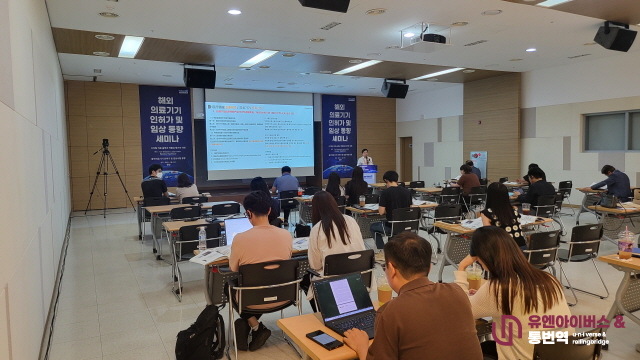
6. Equipment and Technical Operation
Simultaneous interpretation involves more than assigning interpreters.
A professional system may include:
- ISO interpretation booths
- Interpreter consoles
- Wireless receivers
- Transmitters
- Audio distribution
- Language channel routing
- Onsite engineers
- Installation and dismantling
- Technical rehearsals
The quotation must therefore account for the complete operating system, not only interpreter labor.
Why a USD 350 Project and a USD 5,000 Project Can Both Be Reasonable
The difference is not simply the number of hours.
A smaller project may involve:
- One interpreter
- Two languages
- A small meeting room
- No equipment
- Limited preparation
- Controlled discussion
A larger project may require:
- Multiple interpreter teams
- Several language channels
- Interpretation booths
- Hundreds of receivers
- Audio engineers
- Relay interpretation
- Presentation review
- Terminology management
- Rehearsals
- Panel discussions
- High-difficulty Q&A
These are not the same service offered at different prices.
They are fundamentally different communication systems.
Key Pricing Factors
Pricing Factor | Description | Cost Impact |
Interpretation Method | Consecutive or simultaneous | Very High |
Event Structure | Presentation, negotiation, panel discussion, or Q&A | Very High |
Language Combination | Bilingual or multilingual | High |
Subject Expertise | General business, IR, medical, legal, policy, or technology | Very High |
Numerical Data | Financial, technical, statistical, or clinical information | High |
Audience Size | Small meeting or large conference | High |
Equipment | Booths, consoles, receivers, and audio routing | Very High |
Technical Operation | Engineers, rehearsal, installation, and onsite support | Very High |
Preparation Time | Advance materials or last-minute preparation | High |
Quality Standards
Interpretation costs should be evaluated together with the quality and operational standards required for the event.
Quality Area | Description |
Terminology Accuracy | Accurate and consistent delivery of specialist terminology |
Numerical Accuracy | Correct communication of figures, units, percentages, and comparisons |
Context Preservation | Protection of the speaker’s meaning, purpose, and logical structure |
Q&A Responsiveness | Immediate and accurate handling of unscripted questions |
Audience Comprehension | Clear delivery appropriate to the audience profile |
Real-Time Error Control | Prevention and rapid correction of interpretation errors |
Technical Stability | Reliable audio, receivers, booths, consoles, and language channels |
Operational Readiness | Preparation for scheduled sessions and unexpected situations |
Interpretation fees should be understood as the cost of securing accuracy, continuity, and operational stability.
How We Design an Interpretation Project
Step 1. Define the Event Objective
We identify whether the event is intended to:
- Inform
- Persuade
- Negotiate
- Present
- Educate
- Promote
- Support a decision
Step 2. Select the Interpretation Method
We determine whether the event requires:
- Consecutive interpretation
- Simultaneous interpretation
- A hybrid operating structure
- Relay interpretation for multiple languages
Step 3. Review the Program Structure
We assess:
- Prepared presentations
- Panel discussions
- Live Q&A
- Breakout sessions
- Interviews
- Negotiations
- VIP meetings
Step 4. Confirm the Language Structure
We identify:
- Source and target languages
- Number of language channels
- Direct interpretation requirements
- Relay interpretation requirements
Step 5. Assess Technical Requirements
We review:
- Venue audio systems
- Interpretation booths
- Receiver quantities
- Console requirements
- Online or hybrid platforms
- Onsite engineering requirements
Step 6. Determine Specialist Requirements
We assess whether the event involves:
- Financial data
- Contracts
- Medical information
- Public policy
- Technical specifications
- Regulatory language
- Sensitive negotiations
This process allows the quotation to reflect the actual communication structure rather than an arbitrary hourly rate.
AI + Human Expert Integration
UNIVERSE RB integrates AI and professional expertise through clearly separated responsibilities.
AI-Assisted Functions
- AI may support:
- Event structure analysis
- Presentation keyword extraction
- Preliminary terminology organization
- Subject classification
- Document pre-analysis
- Repeated-content processing
- Caption support for selected segments
Human Expert Responsibilities
Professional interpreters and project specialists remain responsible for:
- Interpretation strategy
- Final terminology decisions
- Contextual judgment
- Live interpretation
- Q&A response
- Speaker intent
- Onsite decision-making
- Communication risk management
The principle is clear:
AI supports analysis. Professional experts remain responsible for the final communication quality.
Industries We Support
- Investment · Investor Relations · Global Business
- Public Policy · Global Governance
- Healthcare · Medical Innovation
- Advanced Manufacturing · Industrial Systems
- Artificial Intelligence · Digital Transformation
- Legal · Contractual Communication
- International Trade · Supply Chain
- Education · Academic Conferences
Interpretation pricing is not only a question of language.
It is an operational design decision shaped by the communication structure, subject matter, and risk level of each industry.
Frequently Asked Questions
Why is interpretation not priced only by the hour?
Because event structure, Q&A requirements, language combinations, specialist knowledge, equipment, and onsite operation all affect the workload and communication risk.
What is the main difference between consecutive and simultaneous interpretation?
Consecutive interpretation is designed around direct dialogue between participants.
Simultaneous interpretation is designed around real-time delivery through an integrated technical system.
Why does simultaneous interpretation cost more?
The project may require two interpreters per language, interpretation booths, consoles, receivers, audio systems, technical engineers, installation, rehearsals, and onsite operation.
Which events usually cost more?
Costs generally increase when the event includes:
- Extensive Q&A
- Financial or technical data
- Specialist terminology
- Multiple languages
- Relay interpretation
- Large audiences
- Complex equipment
- Limited preparation time
Can interpretation equipment be excluded?
Equipment may be unnecessary for consecutive interpretation or very small meetings.
Professional simultaneous interpretation normally requires booths, consoles, receivers, audio routing, or an equivalent remote interpretation system.
What information is required for an accurate quotation?
Please provide:
- Event date
- Venue or online platform
- Language combination
- Number of participants
- Event agenda
- Presentation format
- Expected Q&A
- Specialist subject area
- Equipment requirements
Why UNIVERSE RB
UNIVERSE RB does not simply assign interpreters.
We design the communication environment required for successful international events.
Our services include:
- Interpretation strategy consulting
- Event structure analysis
- Specialist interpreter selection
- Presentation and terminology review
- Simultaneous interpretation system design
- Multilingual channel planning
- Booth and receiver configuration
- Audio engineering coordination
- AI-assisted preparation
- Onsite technical operation
- QMS 9-Step Quality Management System
The same interpretation format can produce very different outcomes. UNIVERSE RB designs the result.
Request a Project-Specific Quotation
From business meetings and negotiations to investor presentations and international conferences, UNIVERSE RB recommends the most appropriate interpreter team and cost structure for each event.
To receive a project-specific proposal, please provide:
- Event date and schedule
- Venue
- Language combination
- Number of participants
- Event objective
- Program format
- Expected Q&A
- Specialist subject area
- Equipment requirements
We will assess the complete event structure and recommend an interpretation solution aligned with your communication objectives, operational requirements, and risk level.
Conclusion
Interpretation cost is not simply the price of a language service.
It is the cost of managing communication accuracy, event structure, participant needs, language channels, specialist content, technical operation, and onsite risk.
Consecutive interpretation should be approached as a person-centered communication structure.
Simultaneous interpretation should be approached as a system-centered communication structure.
The correct budget should therefore be determined by the event—not simply by the number of hours.
Interpretation costs are determined by communication risk and event structure, not time alone.
Pricing and Currency Notice
The prices presented on this page are general guidelines in U.S. dollars.
Final quotations may vary depending on:
- Confirmed project scope
- Language combination
- Event schedule
- Interpreter availability
- Technical requirements
- Travel and accommodation
- Applicable exchange rate
- Local taxes and payment conditions
Unless specifically included in the quotation, travel, accommodation, overtime, recording, venue-specific installation, and additional language channels may be charged separately.
Professional and Confidentiality Standards
The case archive presented on this website is based on actual international seminars, policy forums, corporate presentations, business meetings, and industry conferences.
To protect client information and comply with the Code of Professional Conduct, selected project details may be generalized or anonymized.
UNIVERSE RB designs interpretation quality throughout the entire process.
From the initial consultation, we analyze the event objective, audience profile, language structure, subject complexity, technical environment, and onsite operating conditions to recommend the most appropriate communication solution.