
Quotation


Performance
Trump Administration Trade Negotiation Insights Forum Simultaneous Interpretation | U.S. Trade Policy · Global Trade Strategy – UNIVERSE RB
- 2026.01.22
This international trade policy forum explores the Trump administration's trade agenda, global trade negotiations, tariff policies, and the evolving international trade order.
Key interpretation topics include the America First trade strategy, shifts in the multilateral trading system, protectionism and bilateral negotiations, Korea–U.S. and U.S.–China trade negotiations, the USMCA (formerly NAFTA) renegotiation, Section 232 and Section 301 trade measures, non-tariff barriers, supply chain restructuring, economic security, and the growing convergence of trade and national security.
Because international trade policy integrates economics, international law, supply chain management, economic security, and diplomacy, professional interpretation is essential to accurately communicate policy frameworks, negotiation strategies, regulatory measures, and the future direction of global trade.
Public Policy & Global Governance
Category
Description
This category covers interpretation cases related to international policy
forums, public cooperation initiatives, ODA programs, and global governance
topics including environmental and climate policy.
UNIVERSE RB provides integrated services including:
Simultaneous interpretation Consecutive interpretation International conference interpretation Policy document translation QMS-based quality management operations
We support international policy forums, government cooperation meetings, and global governance conferences with stable interpretation environments.
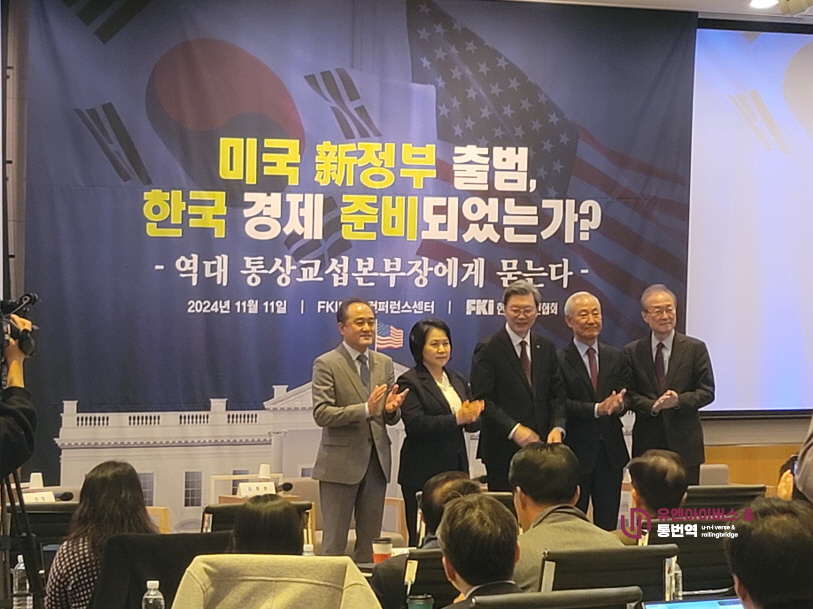
1. Overview
This high-level policy seminar featured former senior trade negotiation chiefs who were directly involved in designing and implementing U.S. trade policy during the administration of Donald Trump.
The forum delivered first-hand insights into U.S. trade strategy, practical negotiation tactics, operational mechanisms of protectionist trade measures, and structural transformations in the global trade order grounded in real negotiation experience.
Participants included trade and economic policymakers, diplomatic stakeholders, corporate strategy executives, research institutions, and academic experts.
Simultaneous interpretation was required to accurately and neutrally convey highly specialized content integrating trade policy, law, diplomacy, and macroeconomic strategy in a formal policy-forum register.
2. Key Topics
Trade Policy Orientation of the Trump Administration
-
Background and objectives of the “America First” trade strategy
-
Reassessment of the multilateral trading system
-
Strategic shift toward bilateral trade negotiations
Major Trade Negotiation Cases
-
Korea–U.S. trade negotiation dynamics
-
U.S.–China trade negotiations and escalation strategies
-
Renegotiation of NAFTA leading to the United States–Mexico–Canada Agreement
Tariff and Non-Tariff Measures
-
Policy rationale behind tariff actions
-
Section 232 under the Trade Expansion Act
-
Section 301 under the Trade Act of 1974
-
Strategic deployment of non-tariff trade pressure instruments
Outlook on the Global Trade Order
-
U.S.–China strategic competition
-
Supply chain restructuring and decoupling risks
-
Expansion of trade–national security linkages
3. Interpretation Format
| Session Type | Content | Interpretation Mode |
|---|---|---|
| Opening | Welcome and institutional remarks | Simultaneous |
| Keynote | Overview of trade strategy under the Trump administration | Simultaneous |
| Policy Sessions | Analysis of major trade negotiation cases | Simultaneous |
| Dialogue Sessions | Interviews with former negotiation chiefs | Simultaneous |
| Q&A Sessions | Audience interaction | Hybrid (Simultaneous + Consecutive) |
| Panel Discussion | Policy implications and forward outlook | Simultaneous |
4. Required Competencies
-
Advanced knowledge of international trade law and economic diplomacy
-
Precise command of FTA, tariff, safeguard, anti-dumping, and subsidy terminology
-
Legal accuracy in handling statutory provisions and regulatory clauses
-
Strict neutrality in politically sensitive discussions
-
Capability to interpret macroeconomic data and negotiation statistics accurately
-
Ability to manage high-density, fast-paced policy discourse
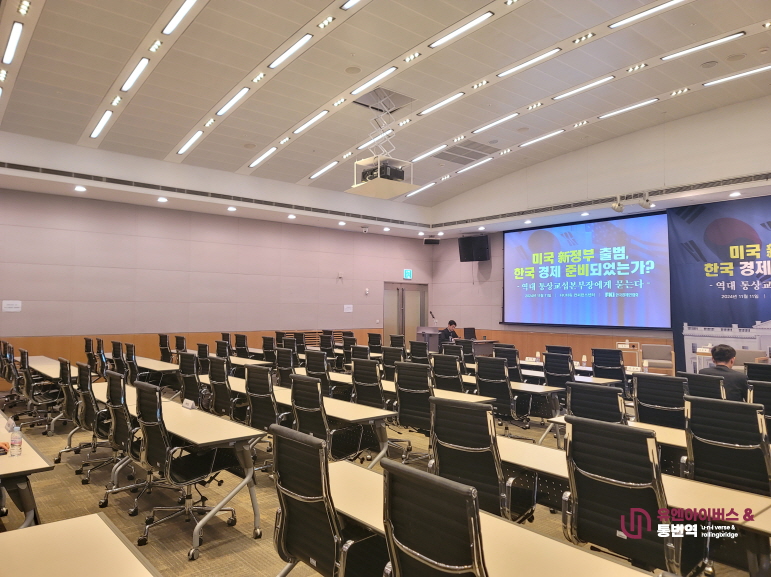
5. Sample Interpretation Cases
-
High-level trade policy forums
-
Government-hosted economic diplomacy conferences
-
U.S.–China economic relations symposiums
-
Corporate geopolitical risk briefings
-
Multilateral trade system reform seminars
6. Interpretation Notes
Accuracy in Trade Terminology
Terms such as Trade Remedy, Safeguard, Tariff Rate Quota, Retaliatory Measures, and Bilateralism may carry different legal implications depending on context. Interpretation must reflect institutional meaning rather than literal translation.
Strict Political Neutrality
Statements involving policy criticism, protectionism justifications, or alliance-related commentary must be delivered faithfully without personal judgment or alteration.
Legal and Institutional Precision
Clause numbers, enforcement dates, tariff rates, and trade deficit statistics must be rendered without numerical error.
Policy Forum Register
Interpretation should maintain a formal, analytical, and measured tone appropriate for expert-level policy discussions.
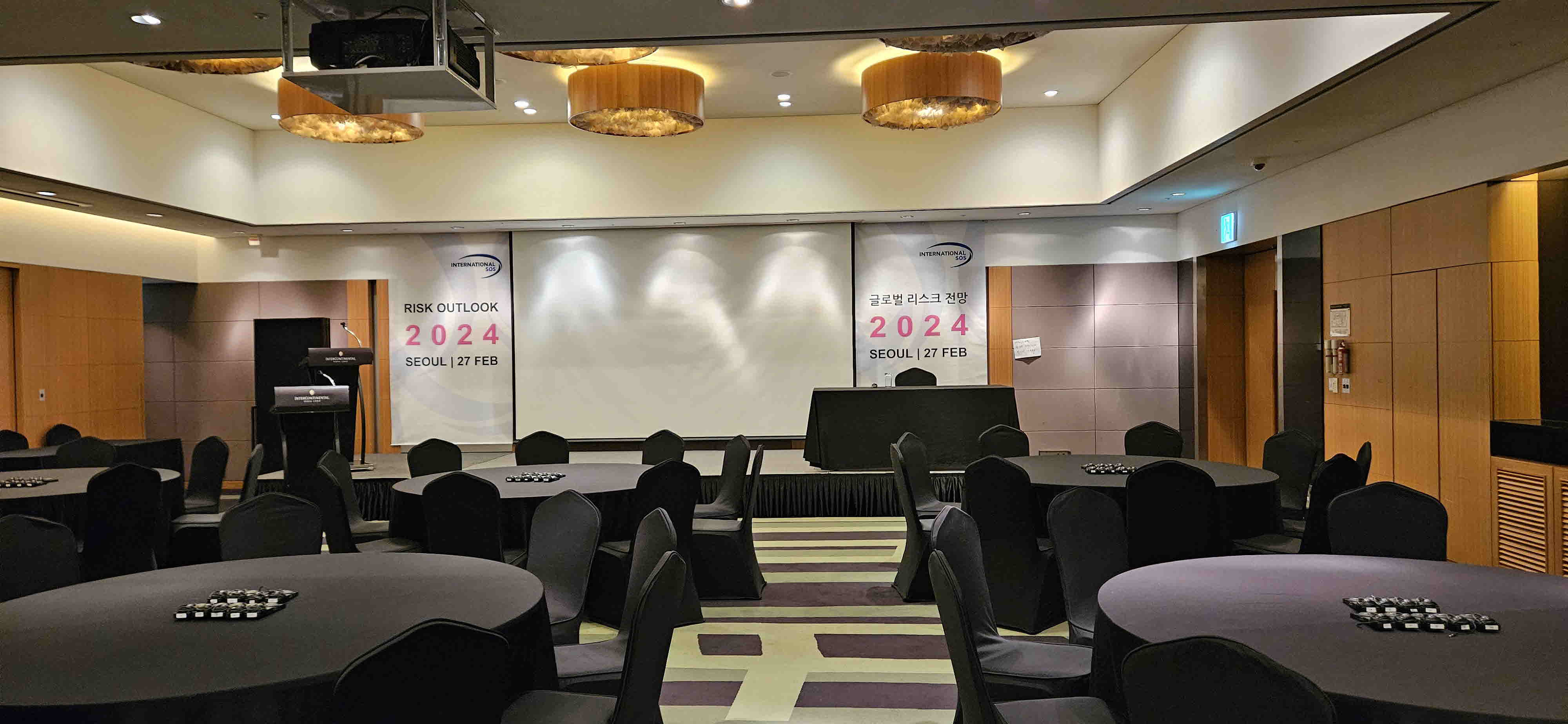
7. Practical Case Analysis
Case 1 – Section 232 and National Security Framing
When speakers justify steel and aluminum tariffs using national security arguments, phrases such as “economic security is national security” require careful rendering to preserve policy context without amplifying political tone.
Case 2 – U.S.–China Negotiation Phases
When discussing Phase 1 Agreement implementation terms, interpreters must process figures, timelines, compliance mechanisms, and retaliatory measures simultaneously—requiring advanced multi-layer processing skills.
Case 3 – NAFTA vs. USMCA Comparison
Sessions comparing NAFTA and USMCA involve detailed regulatory differences, including automotive rules of origin and labor provisions, requiring structural clarity in delivery.
8. Pricing Determination Conditions
Interpretation fees for trade and policy seminars are determined based on the following factors:
-
Language combination (Korean–English, English–Korean, multilingual settings)
-
Number of interpreters required (single vs. team interpretation)
-
Event duration (half-day, full-day, overtime)
-
Technical and legal complexity of content
-
Availability of preparatory materials and preparation time required
-
Level of political and diplomatic sensitivity
-
On-site vs. remote or hybrid format
-
Interpretation equipment configuration (booth, IR/FM system, hybrid broadcasting setup)
Trade and policy forums are generally classified as high-complexity events due to elevated preparation requirements and reputational risk considerations.
9. FAQ
Q1. Why are trade and policy seminars considered high-difficulty interpretation fields?
Because they integrate law, economics, diplomacy, and political strategy, where clauses, statistics, and policy context must all be conveyed with precision.
Q2. How are politically sensitive statements handled?
Interpreters maintain strict neutrality, faithfully conveying both content and tone without modification.
Q3. Is prior preparation on legal provisions such as Sections 232 and 301 necessary?
Yes. A thorough understanding of statutory background and implementation history is essential for accurate interpretation.
Q4. Must interpreters be economists?
Not necessarily, but they must possess advanced structural understanding of trade policy and negotiation frameworks.
Q5. Is remote interpretation feasible for such forums?
Yes. However, for high-density policy discussions, on-site simultaneous interpretation generally provides greater stability and accuracy.
10. Summary
Simultaneous interpretation for a forum featuring former trade negotiation chiefs of the Trump administration represents a specialized domain within diplomatic and trade policy interpretation.
It requires:
-
Mastery of advanced trade and legal terminology
-
Strict political neutrality
-
Numerical and statutory precision
-
Deep contextual awareness of global trade dynamics
In high-level trade strategy discussions, interpreters function as strategic communication mediators, ensuring clarity, credibility, and international intelligibility.
This
case represents one of the sessions conducted as part of international policy
cooperation and global governance discussions.
Policy environments and international cooperation frameworks continue to evolve
in response to economic, environmental, and development policy changes.
→ Explore International Policy Forum Cases
https://universerb.com/en/11_en/57?page=39
At UNIVERSE RB, we believe that the best interpretation projects are built on preparation rather than improvisation, systems rather than assumptions, and communication outcomes rather than marketing claims.
Our role is not simply to translate words.
Our role is to help organizations communicate with confidence across languages, cultures, and industries.

About Our Case Archive
The case studies and project insights presented on this website are based on experience supporting international conferences, investor presentations, government forums, executive meetings, technical seminars, and multilingual corporate events.
To protect client confidentiality and comply with the Code of Professional Conduct followed by professional interpreters worldwide, certain project details have been generalized, anonymized, or adapted for educational purposes.
The purpose of these materials is to share practical insights into multilingual communication planning while respecting the confidentiality of every client and every project.
UNIVERSE RB
Designing Communication. Managing Risk. Delivering Understanding.